
Select Page
Why your blog doesn’t have to be perfect

Why your blog doesn’t have to be perfect

Why your blog doesn’t have to be perfect.

Do you cringe anytime someone reads your writing out loud? Does this thought sit in the back of your mind as you are blogging? (or does it stop you from blogging at all?) Blogs can be daunting, but the benefits should outweigh any uncomfortable feelings that you have about writing. For me, speaking comes more naturally than writing. When I write I tend to use too many words trying to assure my message has been conveyed loud and clear and I feel awkward when I hear people reading my words out loud. I push past all my apprehensive thoughts because blogs are a FABULOUS business tool. They are an innovative way to promote yourself or your business and even help boost your search engine ranking. The best part is they are shareable, people are more likely to share a blog they find relatable over a website which gets your brand out to more people.

Critically for me though I keep two things in mind. 1. If I help one person with my blog, whatever the topic that is a win for me and I am amazed at the comments I get from people around the world who appreciate the insights and thoughts that I put into blogs. 2. I journal every day, there is scientific proof this helps stress and I know use blogging as a mechanism to ‘use’ my journal time effectively. Once a week I write a few blogs. It helps me!

I remember the feeling of uncertainty and doubt when I began to write my first blog. I was confident with the content and would have no apprehension speaking to a group of people on the topic, but when it came to writing I had no idea where to start. Over time I developed a system to writing which I use to guide me through each blog, I don’t use it exclusively, but I refer to it to break down a blog when I am spending too much time starting at a blank page.

Know your audience
We are all targeting a different demographic of clients so before you write anything, ensure you have a clear image of your ideal client or customer in your head and write your blog as though you are speaking to them. For me, my ideal client isn’t reading my blog for entertainment. My audience are professionals who are often time poor, they dedicate as certain amount of time each week to expand their thoughts and skills outside of a standard professional development. So as much as I could spend more time adding entertainment to my writing, I know my audience aren’t going to value it as much as the direct, hard facts.

Heading
People will decide whether to read your blog based on your heading, so if there is one area to devote your creativity to, this is it! Workshop a couple of titles both before and after writing your blog. It is important to revisit the title at the end because your blog may have taken a different direction than you initially anticipate so you want the title to fit.

Image
A lot of experts discourage the use of stock photos and I understand that you need to be unique to stand out. However, I don’t have the time or energy to source or create innovative images for every blog or post I do. I prefer to use a stock image and make it unique by adding my brand colours, logo, boarders, backgrounds and graphics. This process only takes a few minutes on an application such as Canva.

Subheading
If your title and image haven’t convinced them, this is the final chance to hook them in. Use 1-2 sentences maximum describing what they will get out of reading your blog.

Body
It is a lot easier for you to write, and a lot easier for other people to read if you write the same way as you speak. Avoid long sentences, complicated words, and break up large bodies of text with subheadings. Remember blogs are supposed to be easy to read and comprehend.

Summary
Briefly summarise the main points of the article.

Call to Action
Alternate your call to action. It doesn’t always have to be ‘booking a call’ or ‘like and share’. Use the opportunity to direct them to free resources, related articles, your website or shop.

When used correctly blogs are an engaging way promote yourself and your services. Your blogs make you relatable so prospective clients will get to know, like and trust you, making them more likely to buy from you. Regular blogging is also an effective tool to boost your search engine rankings, getting more eyeballs on your offer. Write as often as you’re inspired, write the way you speak, it makes your more relatable, put the thesaurus down and just be you!


Love Life, Love YOUR Life

Ferne Eliz King

About Ferne

Ferne is globally recognised and called upon for quickly accelerating complex change to achieve business strategies.  Translating strategies to actionable plans, prioritisation of those actions, engagement from the right people, bringing business architecture to life or your life plan if individual and in many cases driving the change as a program director.  The bottom line is Ferne accelerates businesses or individuals to achieve outcomes and enabling that is her passion.

What's the consequence if you take no action?

“If you do the same thing today as yesterday, your tomorrow will be the same as today”.  Ferne Eliz King

Want To Learn More?

Book a free 15 min call and see how Ferne can help you accelerate your aspirations for you or your business.

Swimming in your lane. How well do you know your role?

Swimming in your lane. How well do you know your role?

Swimming in your lane. How well do you know your role?

We all have a role to play in the workplace, as we do in life. Due to the complexities of many projects in medium and large corporations, many adopt a swim lane diagram that demonstrates the role of each individual or team, along with who and when they should liaise with those in other lanes along the way. Challenges occur when people from other lanes come across interfere with your role, when others expect you to come across and help fulfill their role as well as your own, or when you cannot let go of obstacles that are not yours to overcome.

I recently discussed the organisation and synchronisation formula one pitstop crew. (Do your employees work like a well-oiled machine?)  To summarise, each crew member needs to be doing the right thing, in the right place at the right time, and while they need to be aware of what everyone else is doing they must solely focus on their own role. It would be a wonderful world if the same organisational skills could be said for the corporate world but unfortunately it is rarely the case. Afterall there is more room for error with a timeline much longer than 16 seconds!

So… How do we stop someone from swimming in our lane? And if someone repetitively interferes in our role how do we resolve it?

The best way to keep people out of your lane is to know your job and preform it well. Take pride in what you do, work hard, and be professional. Demonstrate confidence and let your strengths shine through. This does not mean be unapproachable or closed minded, it is important to be open to new ideas but recognise that you are the expert and ultimately it is your role to make decisions, ensure quality is applied to outputs and get the outcomes as soon as possible – safely.

To keep people out of your swim lane it is equally important to stay out of other people’s lanes. The more focus you give to the activities of others, the more momentum you will lose, (making it difficult to work hard and do your job well as mentioned above). If you believe someone to be underdelivering, it only becomes your concern if you are their manager, or if it directly impacts your work. No one enjoys being micromanaged, so it is important to trust others, give them space to fulfill their role, and even learn from their own mistakes.

However, occasionally you will encounter a co-worker that will come into your swim lane regardless of how well you’re a preforming which can be frustrating and an uncomfortable thing to overcome. So, let’s discuss some strategies to resolve this problem politely but effectively.

The best approach is to speak up. As obvious as this sounds to some, these conversations are often avoided as they can be uncomfortable. Some co-workers may genuinely believe they are being helpful, as for the others, politely reminding them of their place is important. Using respectful but confident communication and body language will be an asset. Demonstrate this by speaking slowly, keeping your shoulders and chin up, keeping your hands still or making only deliberate gestures and engaging with eye contact so they feel as though you are hearing them. There is no need for a long conversation, a quick reminder of your role with a direct factual response about what you are doing and why, and how your and management are confident in the roadmap you have set out.

For example:
“Thanks for reaching out with your ideas. Right now I am having success with (insert practice) which (managers name) has been satisfied with. I will reach out for suggestions if I need assistance in the future. .” Another successful approach is as follows, but only do so if you heartfelt believe in it or it will come across as false. “I really value the insights and experience you bring to the obstacles I am facing, how about if we set up a regular 1:1 every few weeks to toss around ideas of what to do differently and opportunities” If someone has the energy to help – cautious not to say no at the first encounter.

In most cases speaking up will get your co-worker back into their swim lane. In the rare event that it doesn’t achieve this outcome, don’t feel hesitant about calling on a superior for assistance. A concern of this nature needs to be handled promptly and if you are unsuccessful at managing it yourself this is the next logical step. If you present your next step to your co-worker in a respectful way they may be more willing to agree on a arrangement between the two of you.

Try saying:
“I don’t feel like we are coming to a resolution. To get us in agreement sooner rather than later, how would you feel about sitting down to a meeting and asking (a member of management or HR) to join us to mediate?”

The bottom line is if you demonstrate confidence in the way you preform your job people will be less likely to interfere in your swim lane. So keep your head down, take initiative, continue to improve your skills and practices and do your job well, while listening out for those gems of advice you will get along the way. Look for the balance of interference vs insights that ad value.

Love Life Love YOUR Life

Ferne Eliz King

About Ferne

Ferne is globally recognised and called upon for quickly accelerating complex change to achieve business strategies.  Translating strategies to actionable plans, prioritisation of those actions, engagement from the right people, bringing business architecture to life or your life plan if individual and in many cases driving the change as a program director.  The bottom line is Ferne accelerates businesses or individuals to achieve outcomes and enabling that is her passion.

What's the consequence if you take no action?

“If you do the same thing today as yesterday, your tomorrow will be the same as today”.  Ferne Eliz King

Want To Learn More?

Book a free 15 min call and see how Ferne can help you accelerate your aspirations for you or your business.


Practice what you Preach

Practice what you Preach

Practice what you Preach

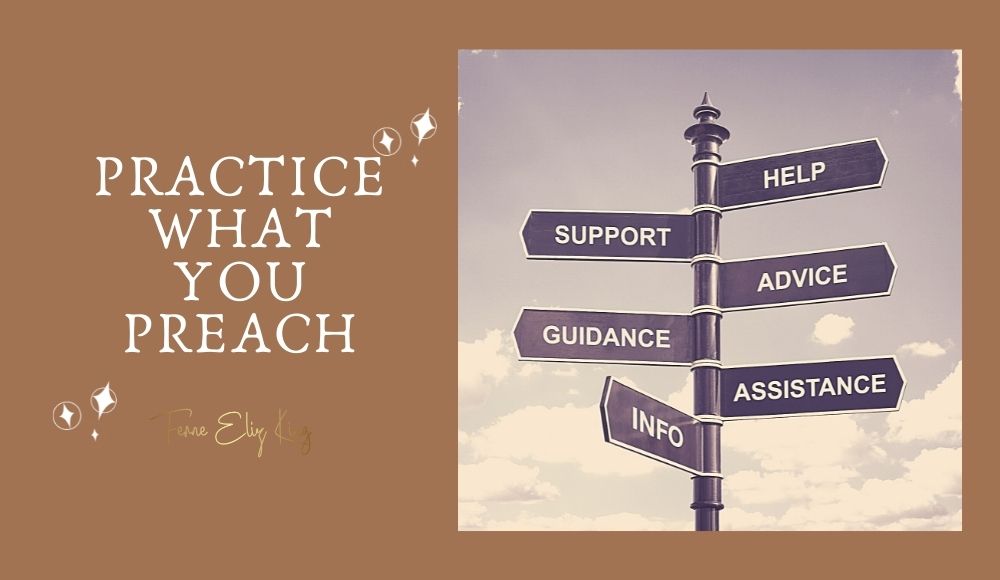
Living by your own advice enables you to be the type of person that you admire.

Giving advice is a lot easier than receiving it, even when the advice has come directly from your own mouth. People tend to give advice to lift their own self-worth and sense of importance. Being on the receiving end generally has the opposite affect, and we must decide whether we accept the advice from others. There are tips we should all follow.

When someone comes to you with a problem, take a strong look in the mirror and consider whether you have the knowledge and experience to have an opinion, and if it is advice that you follow yourself, before offering any counsel.

People often confuse hearing someone venting a frustration with asking for advice, and we are quick to jump to solution mode when sometimes all the other person wants is for someone to hear them.

We could all work on being a better listener.

When someone offers you advice in your personal life, do not be so quick to dismiss it. We are often too emotionally entwined with our own problems and it is a lot easier for others to see the big picture. You ultimately have the power of choice, and not every piece of advice is going to be right for you but take some time to self-reflect before you make that decision.

If you are a leader or manager of a corporation. Practice what you preach!

It seems so obvious but all too often I see managers who have forgotten where they have come from and forgotten their role. Your role is to lead and support, not to direct and delegate. The way you conduct yourself in the workplace will have a direct impact on how those under you will behave.

Hypocritical is unfortunately a word that describes some managers, and it is both frustrating and disrespectful to the employees who look up to them. I’m not stating that these managers have chosen to behave this way- ultimately, I believe it’s a question self-awareness. Here are some examples of the ‘do as I say, not as I do’ approach to management.

The manager that:

  • Disciplines employees for coming to work late, but they arrive late for most meetings
  • Promotes strong customer service, only to be hostile towards a customer with a complaint themselves
  • Limits coffee breaks, but takes an hour and a half for lunch most days
  • Reminds employees not to spend work time on personal tasks, but then takes a 45minute personal call later that day
  • Insists on continual improvement yet never seeks to develop their own professional knowledge
  • Promotes teamwork and unity, but frequently puts individuals or other divisions down

As you can see some of these are quite subtle and easily things you may not notice in yourself but see clearly in other people. They are all quite common mistakes. But these mistakes can be cancerous to the overall work culture.

They good news is, owning your mistakes will restore some credit with your employees. If you begin to actively take your own advice you will begin to rebuild trust which will cause your employees to work harder and begin to take the initiative needed to grow a successful company.

So when you offer someone advice or direction, consider how the words can be applied to your own practices. There is a strong chance it is something you need to hear too!

Love Life  Love YOUR Life

Ferne Eliz King

About Ferne

Ferne is globally recognised and called upon for quickly accelerating complex change to achieve business strategies.  Translating strategies to actionable plans, prioritisation of those actions, engagement from the right people, bringing business architecture to life or your life plan if individual and in many cases driving the change as a program director.  The bottom line is Ferne accelerates businesses or individuals to achieve outcomes and enabling that is her passion.

What's the consequence if you take no action?

“If you do the same thing today as yesterday, your tomorrow will be the same as today”.  Ferne Eliz King

Want To Learn More?

Book a free 15 min call and see how Ferne can help you accelerate your aspirations for you or your business.
Managing Change in your personal or professional life

Managing Change in your personal or professional life

Managing Change in your personal or professional life

It is human nature to fear change. Neuro research has found that our brain reacts to uncertainty in the same way it reacts to an error. This explains why our initial reaction to change is resistance. However, we cannot avoid change as it is fundamental for growth and success.

As necessary as it may be, fronting change can cause a lot of disruption to individuals and business. If you are about to encounter a change, resist the urge to resist and take a moment to contemplate these 15 ways to manage change. Remember “There is nothing wrong with change, if it is in the right direction.”- Winston Churchill.


  1. Understand What You Can Control
    It is unlikely that you will have complete control but ask yourself if there is anything (even the smallest thing) that you can do to feel more in control. For example, your company is downsizing, you will be moved to a new building where your workspace will be significantly reduced. You do not have control over this, but you can sort through and reorganise your workspace.
  2. Be Proactive
    Be proactive about anything that is within your control. Start by setting some goals or making a list of what action is needed to get results. The more prepared you are the less overwhelmed you will feel.
  3. A positive Attitude Changes Everything
    There is always a silver lining, no matter how small. It is very easy and almost natural to dwell on the negatives, but this headspace will cause resistance which is counterproductive. Take a moment to really deliberate a positive in your scenario, this will take a weight off you to help your mindset as you navigate your change. A lot of the time it is not as bad as it first seems, we just fear the unknown.
  4. Accept And Acknowledge
    Whether you like it or not, the change is going to happen. Recognising and accepting the change is the most productive way to move forward. It might not be comfortable to begin with, but you will get used to it. The sooner you accept the change the smoother the transition will be.
  5. Familiarise And Be Flexible
    Begin familiarising yourself as soon as possible. This does not mean you need to be completely across the change overnight. If it is in the workplace, take action to be a part of the change, introduce yourself to the new manager, visit your new office, look over the new business model- the sooner you are familiar, the sooner you will be comfortable. Understand that not everything is going to go to plan and recognise that there will be challenging times and feelings of uncertainty and frustration. Be flexible throughout the transition process and adopt an agreeable attitude- this will help you manage the teething phase.
  6. Take One Systematic Step At A Time
    Approach change slowly but steadily. Changing too much at once will leave you feeling overwhelmed. Prioritise each action that must be taken to achieve the outcome and work down the list. Remember Rome wasn’t built in a day.
  7. Go Easy On Yourself
    If you are undergoing a big change in the workplace, be patient with yourself. No manager will expect overnight success during a large change initiative. To reduce your overall stress levels, accept that it will take time to and understand that no one will, or should, expect immediate change.
  8. Ask Productive Questions
    Again, keeping a positive mindset is fundamental to a smooth transition. Write out all your questions, when you have finished cross out any that begin with a ‘Why’, as these are resistance questions. Put the remaining questions into two categories. The first being ‘productive questions I can ask myself’, and positively framed questions ‘logistic questions to ask management”. Spend time reflecting on any questions you have through a change, you have the full focus of leadership, this is a time to shine. The better quality questions you ask the more informed you will be’.
  9. Communication Is Fundamental
    Keeping these proactive questions in mind, communicate with management, co-workers and team leaders about the change. The better quality of questions you ask, the more familiar you will become, and the more confident you feel. Remember to be positive and constructive in your approach.
  10. Find Your Purpose
    Take time to celebrate your skills, successes and the value you add. Don’t loose yourself during this uncertain time.
  11. Be Considerate
    Be conscious that the change will affect other people in different ways. Don’t get wrapped up in the politics or with those that are resisting that change. Keep yourself positive and connect with supportive peers that are embracing the change.
  12. Keep Up Your Motivation
    Continue to do your job to the best of your ability. You will be notified if the work you are doing will change so don’t sit back and wait for direction. You will make a good impressive if you don’t you the transition period as an excuse to be idle.
  13. Yourself A Break
    It is going to be stressful and overwhelming at times. It is important to manage that stress. During the process of change, put some time aside each day to have some ‘you’ time to relax and unwind. Having something to look forward to each day makes a world of difference. I would also recommend taking a close look at your nutrition and water intake over the stressful period and trial some relaxation techniques such as meditation to clear your head.
  14. Seek Support
    The uncertainty of change can trigger anxiety and emotional stress in some. It is important to confront these feelings and find support in someone you are comfortable with, whether that be a family member, friend or trained professional.
  15. Remember ‘The Only Constant Is Change’
    While it is important to accept, acknowledge and familiarise yourself with the change. Keep in mind that the only constant is change. Don’t get too comfortable with the new order, remain flexible and open to new ideas and ways to achieve.


Ferne Eliz King

Love Life Love YOUR Life

About Ferne

Ferne is globally recognised and called upon for quickly accelerating complex change to achieve business strategies.  Translating strategies to actionable plans, prioritisation of those actions, engagement from the right people, bringing business architecture to life or your life plan if individual and in many cases driving the change as a program director.  The bottom line is Ferne accelerates businesses or individuals to achieve outcomes and enabling that is her passion.

What's the consequence if you take no action?

“If you do the same thing today as yesterday, your tomorrow will be the same as today”.  Ferne Eliz King

Want To Learn More?

Book a free 15 min call and see how Ferne can help you accelerate your aspirations for you or your business.

Effective Ways To Communicate

Effective Ways To Communicate

Effective Ways To Communicate

We are all aware of why effective communication is critical. Employees know their role and work more efficiently, less time spent in meetings with more time achieving outcomes, higher retention and the list goes on and on! But did you know the way you convey your message is more important than the message itself?

These insights highlight the problems with communications.

  • The average employee receives 150+ emails each day and spends 25% of their time at work on emails. 62% of those emails are NOT important (Source: SaneBox)
  • The average employee spends 2.5hrs per day searching for information (Source: IDC)
  • 72% of employees don’t have a complete understanding of their company’s strategy (Source: Tribal Impact)
  • 74% of employees don’t feel up to date with company news (Source: IBM)3

One of the few silver linings from the COVID-19 pandemic is that leaders have had to find new ways to connect and business have started trending towards collaborative communication. As stated there are too many emails going out, they are often impersonal and employees are spending too long sifting through them, often missing important information. The good news is some corporations have adopted techniques during the COVID pandemic that could revolutionise the way we communicate in business.

  • Implementing new communications tools and apps for instant contact between employees working apart, there are many examples where companies have dropped the use of email altogether!
  • Redefining target audiences so information is only reaching employees it is intended for (reducing the time employees spend ‘sifting’ through irrelevant news).
  • When communicating with text, using personalised messages in the subject line to attract attention
  • Using diversity in applications ranging from high priority to low. For example, push notifications for high priority communication, email for low priority and others in between.
  • Getting creative with the way content is shared by using videos, podcasts and infographics- Employees are 75% more likely to watch a video than read text (Source: Ragan); Particularly if it is an informal video recording from the boss to start the week off rather than the dry email that is hard to read.
  • Use employee feedback about their preferred way to receive messages and communicate within their team
  • Devising a way to measure success of internal communications -60% of communication professionals do not measure internal communications. (Source: Workforce)
  • Implement dedicated Flow Time; company wide.  No meetings, no emails and flow time does not equate to catch up on admin. It is Flow Time to work on the stuff that needs prioritisation, creativity, curiosity, inspiration and innovation to solve for.  Get people to work in small teams for Flow Time or individually .. Watch the dial move …. 

Implementing an overhaul to the whole communication system is a daunting concept! The good news is the transformation doesn’t have to happen all at once- it can be taken in steps. You could start by asking employees for feedback on how they would like to see communications operate in the future. You can start sending shorter, and more personalised emails with a catchy subject line to grab attention (and stop sending bulk emails). You can change your weekly newsletter to a weekly podcast or video. The possibilities are endless!  And dont, ever, every send important communications on a Friday.

Corporations with a strong communication system experience the long term advantage of a healthier work atmosphere where employees are more motivated, loyal and engaged. Organisations with effective communication are 3.5 times more likely to outperform their peers (Source: ThinkTalent)

Think of the changes you can implement today!

Love Life, Love YOUR life

Ferne Eliz King

About Ferne

Ferne is globally recognised and called upon for quickly accelerating complex change to achieve business strategies.  Translating strategies to actionable plans, prioritisation of those actions, engagement from the right people, bringing business architecture to life or your life plan if individual and in many cases driving the change as a program director.  The bottom line is Ferne accelerates businesses or individuals to achieve outcomes and enabling that is her passion.

What's the consequence if you take no action?

“If you do the same thing today as yesterday, your tomorrow will be the same as today”.  Ferne Eliz King

Want To Learn More?

Book a free 15 min call and see how Ferne can help you accelerate your aspirations for you or your business.